
Supply disruptions can force lubricant manufacturers to look for alternative base oils and additives. Here’s what has to happen before a substitute can support the performance claims on the bottle.
In Part 1, we looked at why motor oil can become more expensive even when there is plenty of crude oil available.
That raises another question: what happens when a motor-oil manufacturer can’t get the particular ingredients it normally uses?
Motor oil is a carefully balanced formulation of base oils and additives, designed to deliver specific performance in a specific application. Change one component and the manufacturer has to determine how that change affects the finished product.
That is happening now.
JobbersWorld reported that on October 1, the American Petroleum Institute extended its Emergency Provisional Licensing program for another 90 days. API said continuing Middle East disruptions were still causing severe global base-oil supply shortages.
The extension gives us a look at what happens behind the scenes when a manufacturer can’t obtain a material it normally uses.
A Motor-Oil Formula Is a System
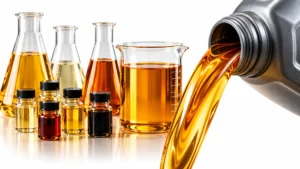 Base oils provide the foundation of a finished lubricant. Additives are combined with those base oils to give the finished oil the properties it needs inside an engine.
A modern formulation can include components that help:
- Keep deposits and contaminants under control
- Protect loaded metal surfaces from wear
- Resist oxidation and heat-related breakdown
- Control friction
- Maintain useful viscosity as temperatures change
- Protect against corrosion and foaming
The ingredients work together.
A manufacturer cannot necessarily remove Base Oil A, replace it with Base Oil B and expect the original formulation to behave exactly the same way. The change can affect viscosity behavior, volatility, oxidation resistance, deposit control, cold-temperature performance or the way the additive system behaves in the finished blend.
That’s why changing an ingredient is a formulation problem, not simply a supply problem.
Can’t They Just Use Another Base Oil?
Sometimes an alternative can work. Determining that is the job.
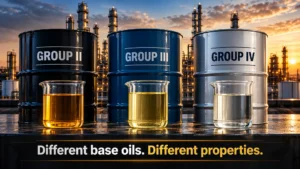 Base-oil categories such as Group II, Group III and Group IV describe different types of base stocks with different characteristics. A motor-oil formulation is built around the properties of the base oils and additives selected for that product.
That connects directly to the Group III shortage discussed in Part 1. Group III base oils require specialized refining processes and production capacity. More crude oil does not automatically create more Group III base oil, and an available alternative has to be evaluated as part of the finished formulation.
The refinery economics discussed in Part 1 remain part of the recovery outlook. JobbersWorld reported that strong diesel margins remain another variable affecting Group III availability.
Refinery design, operating requirements and contractual commitments vary, so the economics do not produce one uniform industry response.
What API’s Emergency Program Does
 API’s Emergency Provisional Licensing program provides a temporary pathway for qualifying API licensees facing a significant industry-wide supply disruption.
A manufacturer seeking emergency relief identifies the affected products and proposed substitution, provides technical information supporting the substitute’s ability to maintain the claimed performance, and completes the testing required under the program.
The temporary arrangement operates within the conditions and time limits of the emergency program.
When the emergency period ends, the manufacturer must return to the original formulation or obtain the appropriate standard licensing for a revised formulation, following the required testing and approval process.
The lubricant industry already has established procedures for evaluating certain base-oil substitutions and viscosity-grade read-across. Emergency Provisional Licensing provides an additional route when a qualifying supply disruption makes the normal formulation difficult or impossible to maintain.
That tells us something important about what happens when the supply chain breaks:
The manufacturer has to solve the formulation problem, not simply find another barrel of oil. The Independent Lubricant Manufacturers Association (ILMA) explains that the emergency program requires manufacturers to identify substitutions and provide technical information supporting them.
How Much Is Actually Changing?
API’s extension confirms that the base-oil disruption remains serious enough for the emergency mechanism to stay in place.
But that doesn’t tell us how many companies are actually using Emergency Provisional Licensing, how many formulations are involved or how many finished oils have changed under the program.
JobbersWorld noted that the extent of EPL use remains unclear.
Here is what we do know:
- The base-oil supply problem is continuing.
- API has kept its emergency mechanism active.
- Qualifying manufacturers have a documented way to evaluate temporary substitutions.
- The scale of actual formula changes across the motor-oil market has not been publicly disclosed.
That distinction matters.
An emergency licensing program being available does not mean that every motor oil on the shelf has been reformulated.
Does This Mean Motor Oil Is Being Made With “Cheaper Stuff”?
A manufacturer may change a source or substitute a different base oil or component when its normal supply becomes unavailable.
But the substitute still has to work within the complete formulation and support the performance requirements attached to the finished product.
ILMA made an important clarification when the emergency program was activated: the program did not authorize a blanket substitution of Group II base oils for Group III in products marketed as synthetic. Individual licensees remain responsible for the applicable performance and labeling requirements. ILMA’s explanation of the program also outlines the conditions and limitations on those substitutions.
AMSOIL has described the same broader pressure on base oils, additives, packaging and transportation in its Dealer communications this year. Its October Dealer Edition reported substantial increases in the cost of certain base-oil raw materials and explained that formulation changes caused by supply pressure do not, by themselves, demonstrate a broad decline in lubricant quality.
The finished oil is what ultimately has to perform.
API Is Only One Layer
API licensing is one part of the engine-oil certification and approval picture. Some products also carry requirements established by vehicle manufacturers.
That creates another consideration when a formulation changes.
Earlier this year, ILMA asked General Motors for temporary flexibility related to its dexos program during the Group III supply disruption. The request illustrates why an API emergency pathway does not automatically resolve every OEM requirement.
For an oil carrying an OEM approval, the manufacturer has to consider the requirements of that approval along with the applicable API category. ILMA reported GM’s response to the request for temporary dexos flexibility: GM declined to suspend enforcement actions, but said it would expedite case-by-case reviews of alternative base oils and formulations.
The Finished Oil Is What Matters
When a key ingredient becomes difficult to obtain, finding a replacement is only the beginning.
The manufacturer has to understand what the original ingredient contributed, determine whether an alternative can perform that role, evaluate the complete blend and support the performance claims made for the finished oil.
That’s why the question isn’t simply, “What’s in the bottle?”
It’s also, “What does the finished oil demonstrate that it can do?”
Base oils, additives, formulation, testing, specifications and approvals all come together in the product sitting on the shelf.
With the lubricant supply chain still under pressure, understanding that process gives us a better way to look at what is happening inside the bottle.