Synthetic lubricants did not begin with AMSOIL. Their story reaches back decades earlier, as chemists and engineers searched for ways to create lubricants that could outperform conventional petroleum oils in extreme cold, severe heat, and high-stress machinery.
Over time, advances in chemistry, military research, aviation, and engine technology moved synthetic lubricants from specialized applications into the automotive world. That larger history is what eventually set the stage for AMSOIL’s emergence in the early 1970s.
The First Steps
One of the most important developments behind synthetic lubricants was the rise of organic synthesis, which gave chemists the ability to design molecules for specific purposes rather than relying only on what nature provided. That shift made it possible to create more uniform, purpose-built fluids that could improve on the weaknesses of conventional lubricants.
The first synthesized hydrocarbons are generally traced to the work of Friedel and Crafts in 1877. Commercial efforts came later, including an early attempt by Standard Oil of Indiana in 1929, but demand remained limited and the market was not yet ready for synthetic lubricants.
Aviation and Wartime Demand
 Synthetic lubricant development gained momentum when conventional petroleum oils showed clear limits in harsh environments. AMSOIL’s history article notes that World War II exposed the shortcomings of petroleum oil, especially in severe cold where conventional oil could thicken or solidify and make engines and equipment difficult to start.
At the same time, European and American researchers were developing ester-based synthetic fluids for demanding uses. Germany evaluated thousands of synthetic esters between 1938 and 1944, while the U.S. Naval Research Laboratory developed early diester synthetic base oils during the 1940s.
The Jet Age
The real turning point came with the rise of advanced aircraft and jet engines. Conventional oils could not provide the wide-temperature protection and stability required for high-speed, high-heat aviation service, while synthetic lubricants proved capable of delivering that protection.
That aviation connection matters because it explains why synthetic lubricants were first respected in fields where failure was not acceptable. Before synthetic motor oil reached ordinary drivers, synthetic technology had already earned credibility in military and aerospace environments where performance demands were far beyond normal automotive use.
From Aircraft to Automobiles
As synthetic lubricants proved themselves in aircraft, the question naturally followed: could the same advantages apply to automobiles? Better low-temperature flow, improved high-temperature stability, stronger wear protection, and longer service life all pointed toward a broader future.
Still, adapting synthetic lubricants to cars and trucks was not simple. Automotive engines faced dirt, combustion by-products, stop-and-go use, and a much broader range of consumer expectations, so the challenge was to deliver synthetic benefits in a practical automotive setting.
The Road to AMSOIL
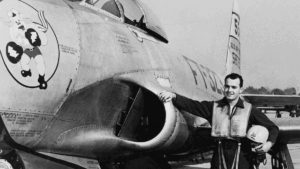 That broader technical history eventually led to AMSOIL. After becoming familiar with synthetic lubricants in jet aircraft, Lt. Col. Albert J. Amatuzio began researching how their advantages could be applied to automotive engines, first experimenting with petroleum oils and later focusing on synthetic base stocks and additive chemistry.
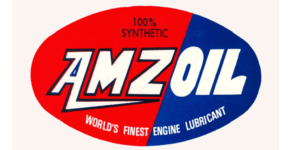
By the late 1960s, he was commercially selling synthetic motor oil formulations, and the AMZOIL name had been established before later changing to AMSOIL. In 1972, AMSOIL Synthetic Motor Oil became the world’s first synthetic motor oil to meet API service requirements, linking decades of synthetic-lubricant development to a landmark moment in automotive oil history.
The Industry Begins to Shift
Once synthetic motor oil had proven itself, wider industry acceptance followed gradually rather than all at once. AMSOIL notes that synthetic oil was initially resisted by much of the petroleum industry and by manufacturers who considered conventional oils good enough, but changing engine demands and the need for better protection slowly shifted opinions.
As more companies entered the market and more synthetic products were developed, synthetic lubricants became an increasingly important part of modern engine design and maintenance. What began as specialized chemistry for extreme applications grew into one of the most important developments in automotive lubrication.
Modern Definitions of Synthetic Oil
Today’s market includes several different types of synthetic oils sold under the synthetic label. Early synthetic‑oil history often centered on PAO and ester base stocks, but today Group III base oils, which are derived from crude oil and heavily refined, can also be marketed as synthetic in most countries.
That means modern synthetic motor oil is not limited to one type of base stock. For this page, the key point is simple: the early history of synthetic lubricants was built on purpose‑designed fluids, while today’s market includes several different types of synthetic oils that meet the modern definition.
 Why This History Matters
This history matters because synthetic motor oil was not simply a product trend or a marketing invention. It was the result of decades of chemical development, wartime necessity, aerospace innovation, and engineering work aimed at solving real lubrication problems.
AMSOIL did not invent synthetic lubricants, but it played a major role in bringing synthetic motor oil into the automotive mainstream and helping prove its value to drivers and equipment owners.