As an AMSOIL Dealer, I’ve been hearing more questions about lubricant prices this year, including my own and discussions with others I work with. This is one reason I wanted to dig into what is actually happening behind the price tag.
If there is plenty of oil, why does the oil going into your engine cost more?
If you have looked at the price of motor oil lately and wondered, “How did it get this expensive?”, the answer is not as simple as the price of crude oil.
The oil in a bottle is the end of a much longer process. Manufacturers need particular lubricant base oils and additives, then have to blend, package and deliver the finished product. A country can have plenty of crude oil while a specific ingredient needed for a motor-oil formulation is scarce or expensive.
That difference has mattered in 2026. Supply disruptions have tightened the market for certain base oils, while fuel prices and other manufacturing and delivery costs have added pressure. To understand the price on the shelf, we have to look at what happens before the bottle gets there.
Oil Isn’t Just Oil
Crude oil can become many different products. Some of it is processed into fuels; some becomes lubricant base stocks. A finished motor oil combines appropriate base oils with an additive system designed to help it withstand heat, limit deposits, control wear and perform within the viscosity range the application requires.
That means a shortage of one type of base oil affects the oils that depend on it more directly than those built from other ingredients. The distinction is particularly important for Group III base oils, used in many synthetic motor oils. Industry reporting has described Group III and Group III+ supplies as especially tight this year.
If There’s Crude, Why Not Make More Motor Oil?
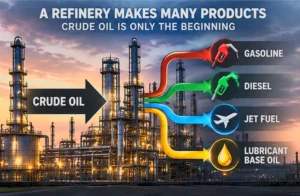 Refineries make a range of products, but not every refinery has the equipment or suitable feedstocks to produce every grade of lubricant base oil. Sending more crude to a refinery does not necessarily create more of the specific ingredient a motor-oil blender needs.
Economics matter, too. A refinery has to weigh the returns from making base oils against competing products where its equipment gives it a choice. In August, Lubes’N’Greases reported that market participants thought some refiners might reduce base-oil output to favor diesel while fuel margins were strong. That was a potential response to market conditions, not a report that every refinery had already made the switch.
Argus provided an important qualification: at the end of August, U.S. Group II base-oil margins were still above diesel margins, although that advantage had narrowed for seven weeks. The economics were changing, but lubricant production had not simply stopped in favor of fuel.
There was also strong demand beyond the U.S. The U.S. Energy Information Administration reported that diesel and jet-fuel prices rose more sharply than gasoline in the first quarter of 2026 and identified increased U.S. exports to Europe as one factor tightening the distillate market. That helps explain the pressure on fuel economics; it does not mean American motor oil was simply diverted overseas.
The point is that plenty of crude is not the same as plenty of base oil. Refinery capabilities, feedstocks, competing demand and the economics of different products all affect what gets made.
So What Happened to Lubricant Supply?
Alongside those refinery economics, disruption to Middle East production and shipping made some lubricant ingredients harder to obtain. By May, AMSOIL was telling its Dealers that damaged production capacity and constrained shipping were driving supplier costs higher. In June, it warned that shoppers might eventually find some familiar lubricant options unavailable.
By September, Lubes’N’Greases was still reporting significant Group III shortages and price increases, including production shutdowns and limits on shipments from the Persian Gulf. Different base-oil groups and grades faced different conditions. For motor-oil makers, the challenge was securing the particular ingredients their formulations required—not simply finding any oil at all.
The price pressure has been working through the system for months. AMSOIL had announced a limited adjustment to selected product prices earlier in the year, citing raw-material, freight and labor costs. Spring and summer brought further production and shipping disruption. By fall, higher costs were becoming more visible at stores and repair shops.
It’s Not Just Base Oil
Even a manufacturer with a reliable source of base oil still needs additives, bottles, labels, blending capacity and transportation. Higher costs at several stages can push up the price of the finished product.
As we move into October, AMSOIL reports increases in the cost of base oils, additives, plastic bottles and shipping. It says base-oil prices had risen 97%–287% from the end of February to the time of writing. That is AMSOIL’s reported range for base-oil raw-material prices—not a claim that every base oil, or the price of finished motor oil, increased by the same percentage.
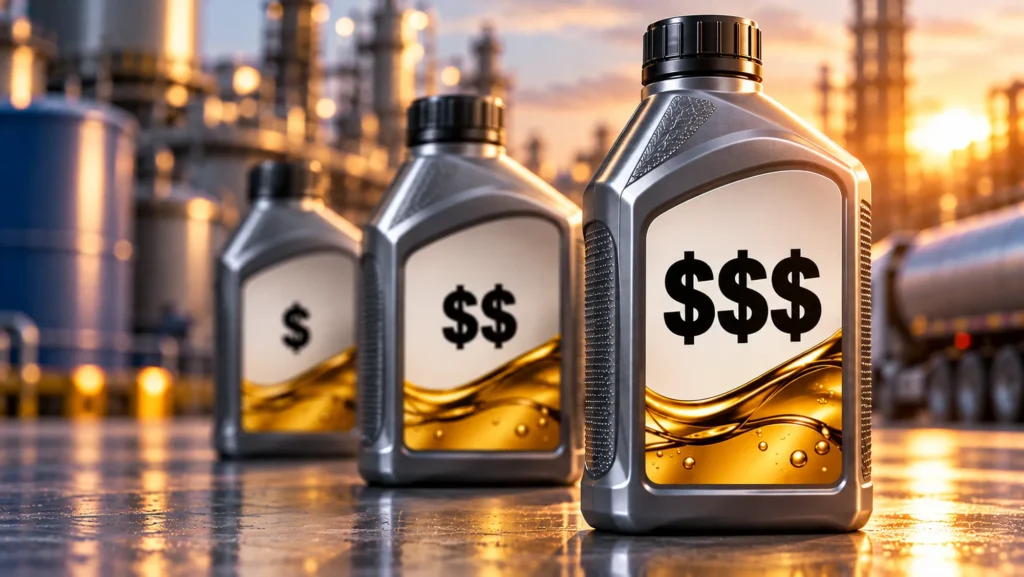
A motor-oil price tag reflects the whole chain, not a single ingredient. That is why a change in crude-oil prices alone cannot tell you what the next bottle should cost.
Why Can the Price Jump Suddenly?
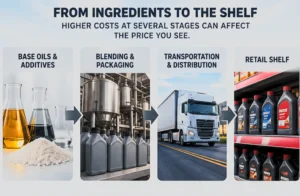 The higher cost of making oil does not always reach the shelf right away. A retailer may still be selling inventory purchased at an earlier price; a repair shop may absorb some increases before changing its service price. When replacement stock arrives, months of upstream pressure can show up in one noticeable jump.
One recent example is Costco’s Kirkland motor oil. Lubes’N’Greases reported that a 10-quart package rose to about $58 from roughly $30–$35, while price changes at other retailers were less abrupt. That example shows what consumers can see when costs finally reach retail; it does not establish what every brand or store will charge next.
Does a Higher Price Mean Different Oil?
Not necessarily. Price alone cannot tell you whether the formula inside a bottle has changed or whether an oil performs better or worse.
Scarce raw materials may cause a manufacturer to seek a different supplier or consider an alternative formulation. Those decisions call for testing and validation, not guesswork. AMSOIL says these pressures do not prove that lubricant quality is broadly declining, even as manufacturers face difficult sourcing decisions. The industry’s response includes an API process for certain temporary substitutions, which we will examine more closely in Part 2.
What Does This Mean For Your Next Oil Change?
If your usual motor oil becomes unusually expensive or unavailable, you may have more choices than “pay whatever it costs” or “use whatever is cheapest.” More than one product may meet your vehicle’s viscosity and performance requirements. Knowing what those requirements are—and how qualifying oils differ—lets you compare options instead of reacting to the price on one shelf.
AMSOIL offers several motor oils with different performance features and price points. If your driving habits or budget have changed, the oil you’ve always used may not be the only AMSOIL option worth considering. What are those choices, and how do they differ? That’s worth exploring before your next oil change.
Next in this series: What happens when a motor-oil manufacturer cannot get an ingredient it normally uses? Part 2 will look at base oils, additives, substitutions, testing and API licensing.