Summer heat can make a vehicle uncomfortable. For an engine, however, the serious heat is already happening inside the machine.
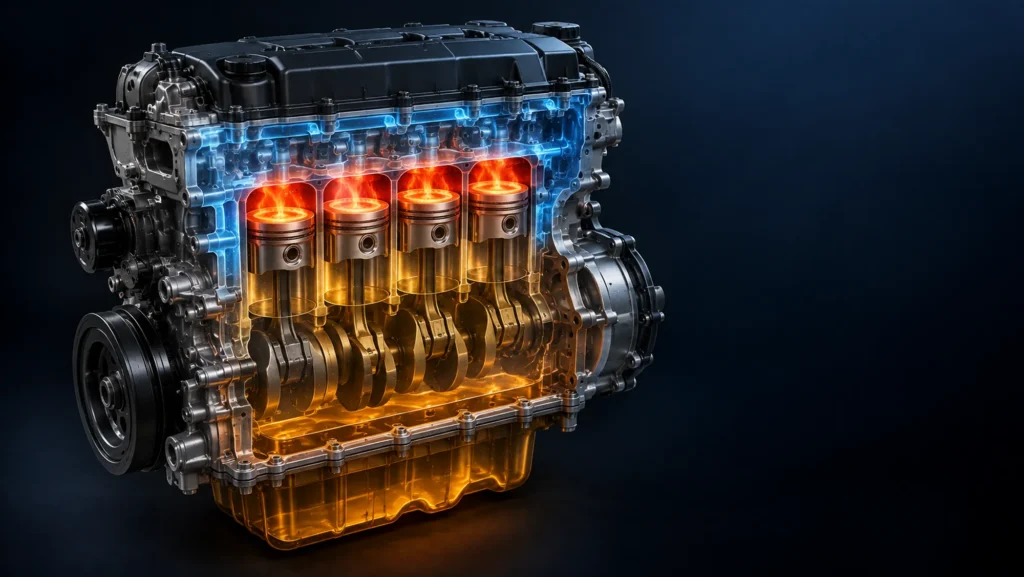
Every time fuel burns in the combustion chamber, the engine produces heat that must be controlled. The cooling system removes much of it, but motor oil has an important job as well. It lubricates moving parts while helping carry heat away from areas where metal surfaces, load and friction are concentrated.
That matters on an ordinary hot day. It matters even more when a truck is towing, a vehicle is climbing hills, a turbocharged engine is working hard, equipment is running at high speed or a vehicle spends long periods idling under load.
In those conditions, the question is not simply whether the engine is running hot. It is whether the oil can continue protecting the engine while heat, oxygen, pressure and time work against it.
Oil Does More Than Lubricate
Motor oil forms a protective film between moving parts, but lubrication is only part of its job. It also helps carry heat away from loaded components, including bearings, pistons, rings, camshafts and turbocharger areas.
Coolant is the primary heat-transfer medium in much of the engine, but coolant cannot reach every surface that needs protection. Oil reaches many of the tight clearances and heavily loaded areas where friction and heat are concentrated.
As oil circulates, it picks up heat and returns it to the oil pan, cooler or other parts of the lubrication system where some of that heat can be released. That is why oil selection matters in hot climates and severe service—not just at oil-change time.
What Heat Does to Motor Oil
Heat does not instantly ruin motor oil. But sustained high temperatures accelerate the chemical processes that gradually degrade it.
The main concerns include:
Oxidation: Heat and oxygen react with oil over time, contributing to thickening, varnish, sludge and deposits.
Volatility: High temperatures can cause lighter portions of an oil to evaporate. Excessive evaporation can contribute to oil consumption, thicker remaining oil and deposit formation.
Viscosity change: Oil must remain within a useful viscosity range to maintain protective film strength and flow.
Deposit formation: Oxidized or overheated oil can leave deposits in piston-ring areas, turbocharger components and narrow oil passages.
AMSOIL explains that oxidation accelerates as temperature rises, and notes that oxidation rate can double for every 18°F / 10°C increase in temperature.
The outside air temperature is only part of the story. Towing, hauling, long grades, stop-and-go driving, high-RPM operation, turbochargers and heavy work can put far more thermal stress on the oil than a normal unloaded drive on the same day.
A Look Back at Heated-Oil Demonstrations
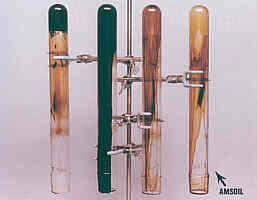
This historic AMSOIL image compares petroleum motor oil and AMSOIL synthetic motor oil after exposure to high temperatures.
The value of a visual comparison like this was simple: it made it easier to see how heat can affect an oil. Under sustained high-temperature conditions, oil can evaporate, thicken, oxidize and contribute to deposit formation.
The oils and technology shown reflect the time when this material was produced. Today, standardized tests and current product data give drivers more precise ways to compare high-temperature oil performance. The underlying question has not changed: how well does an oil resist breakdown, evaporation and deposits when heat builds?
One modern way to measure part of high-temperature oil performance is the NOACK Volatility Test. It measures how much oil evaporates under specified high-temperature conditions. Lower volatility can help reduce oil consumption and limit the tendency for the remaining oil to become thicker as lighter components evaporate.
Modern Engines Give Oil Less Room for Error
Engines have changed significantly since the early days of these demonstrations.
Many current gasoline and diesel engines use turbochargers, direct injection, tighter tolerances, smaller oil passages and sophisticated emissions-control systems. These designs can deliver strong performance and efficiency, but they also create demanding conditions for the lubricant.
Turbochargers are a clear example. They operate at extremely high speed and are exposed to intense heat. After a hard run, the heat does not disappear the moment the engine is shut off. The oil in and around the turbocharger can continue to experience heat soak, making thermal stability and deposit control important.
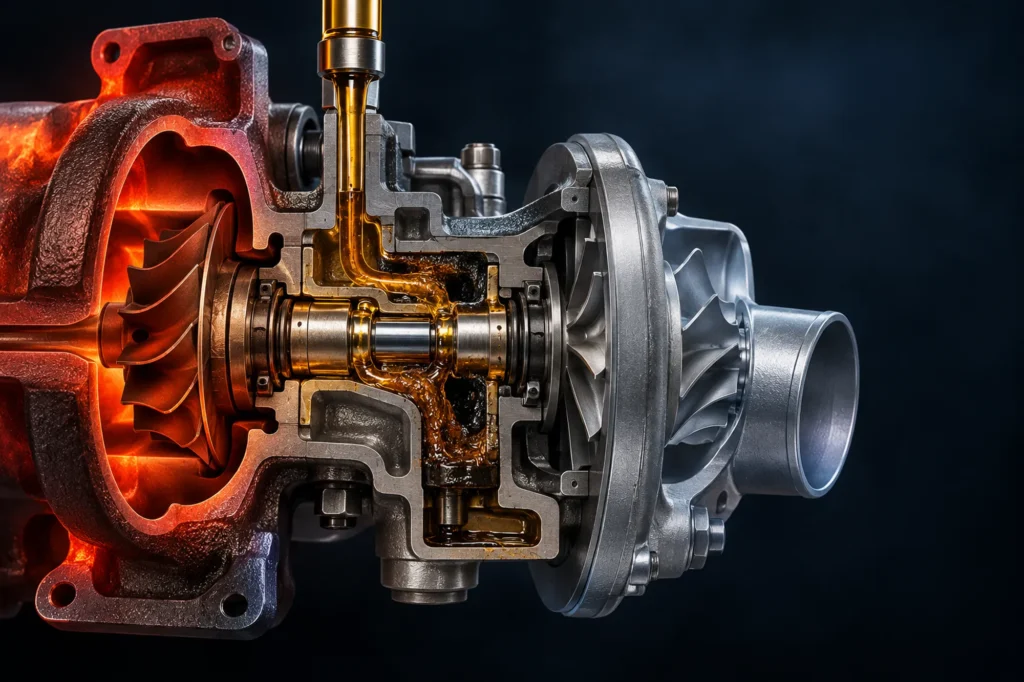
Under severe heat, deposits can form in turbocharger oil passages and bearing areas. This is often called coking. If deposits restrict oil flow, they can interfere with lubrication and cooling of the turbocharger, increasing the risk of damage over time. Good thermal stability and deposit control help reduce that risk.
This does not mean every modern engine requires the most expensive oil on the shelf. It means the oil must meet the manufacturer’s required grade and specification—and that severe use is a good reason to compare the quality of approved options.
Same Grade Does Not Mean the Same Heat Resistance
A viscosity grade and specification are the starting point. They are not the entire story.
Two oils can both be labeled 5W-30 and meet a required specification, yet differ in their ability to resist oxidation, evaporation, viscosity loss or thickening and deposits under sustained heat.
The manufacturer’s required oil grade and specification must always come first. Those requirements establish the oil’s suitability for the engine. Once you know the approved choices, compare current product information and technical data:
High-temperature/high-shear viscosity, where relevant to the application.
NOACK volatility, where the product data makes it available.
Current industry and OEM approvals.
Product-specific claims and test information for towing, turbocharged engines, heavy work or severe service.
This is not about chasing one number or assuming every premium product is automatically right for every engine. It is about choosing an approved oil with performance characteristics suited to the vehicle, equipment and workload you actually have.
Why AMSOIL Is Relevant in Severe Heat
AMSOIL synthetic lubricants are formulated to help resist the high-temperature breakdown, volatility and deposit formation that can challenge oil during hot-weather and high-load operation.
For drivers who tow, haul, operate turbocharged engines, work equipment hard or live in consistently hot climates, that matters because the oil may spend more time at elevated temperature than it does in ordinary commuting.
The goal is not to use a heavier oil simply because the weather is hot. Use the viscosity grade and specification your manufacturer requires. Then, among the approved choices, select a product designed with the thermal stability and high-temperature protection your service demands.
The old habit of using a thicker oil during hotter weather sometimes made sense in older engines with larger clearances and simpler lubrication systems. Many current engines have tighter clearances, smaller oil passages and oil-controlled components. Using a heavier grade than the manufacturer approves can slow flow through those passages and may work against the engine’s lubrication and cooling design.
Rather than automatically moving to a thicker oil for summer, use the correct approved viscosity and choose a product formulated to maintain protection under high-temperature conditions.
Base Oils and Additive Systems Matter
The viscosity number on the bottle is the first thing most owners see, and it is the correct starting point when it matches the manufacturer’s requirement. But it is not the entire story.
Oil formulation begins with the base oil, then adds a carefully balanced package of detergents, dispersants, antioxidants, anti-wear chemistry, viscosity modifiers and other components. The base oil contributes important characteristics, including how the finished lubricant handles temperature, oxidation, volatility and flow.
Modern Group II and Group III base oils can provide strong performance when properly formulated. PAO base oils, commonly associated with Group IV, have excellent inherent thermal and low-temperature properties. But base-oil group alone does not decide overall quality: a well-formulated Group III synthetic can outperform a lesser formulation built around Group IV base oil, while a high-quality conventional or synthetic blend can outperform a weaker product in certain tests.
That is why comparing only a base-oil category—or only the viscosity label—does not tell the complete story. The finished formulation, current approvals, technical data and intended service all matter.
For most drivers, a properly selected synthetic oil offers meaningful extra margin for high heat, heavy work and long-term cleanliness. AMSOIL offers several synthetic choices for different applications and service levels. The best choice depends on what the manufacturer requires and how the vehicle or equipment is actually used.
Published September 2026. This page is reviewed periodically. Always follow current manufacturer requirements and product documentation for your vehicle or equipment.