
A 40°F morning may feel cold in Florida, but in the Upper Midwest, northern Plains, Canada, Alaska and other severe-winter regions, it can be a mild day.
In those colder climates, a vehicle, truck or piece of equipment may sit outside overnight at temperatures well below freezing—sometimes way below 0°F—and still has to start, circulate oil and go to work.
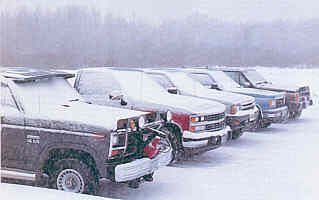 At those temperatures, the battery has less available power, the starter has more resistance to overcome and engine oil becomes much more resistant to flow. The question is not simply whether the engine eventually starts. It is how quickly the oil can crank, pump and circulate through the engine after it does.
AMSOIL is based in Superior, Wisconsin, next to Duluth, Minnesota—an area that understands severe winter conditions. Cold-weather performance has never been an abstract subject there. It is part of daily vehicle and equipment operation for a significant part of the year.
The AMSOIL Dealer Cold-Flow Demonstration
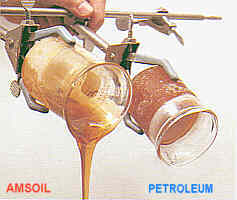 In the early years of synthetic motor oil, AMSOIL dealers in colder climates often used a simple cold-flow demonstration to explain what drivers and equipment owners were seeing in real winter conditions.
They would place AMSOIL synthetic oil and popular conventional oils of the day in the same freezing environment, then tip the containers. In severe cold, the difference could be obvious: conventional oil might barely move, while the synthetic oil would still pour.
For people who had struggled to get a vehicle, pickup, truck or work machine started after it sat outside overnight, the demonstration made a practical point. It showed why cold flow mattered—not as an abstract laboratory number, but as something that could affect whether equipment was ready for work in the morning.
The Principle Has Not Changed
Modern conventional oils and synthetic blends are far better than many of the products used in early synthetic-oil demonstrations. Modern engines have also become more demanding, with tighter passages, turbochargers and oil-controlled components such as variable-valve-timing systems.
The basic question, however, is still the same:
When temperatures fall far below freezing,
how readily can the oil still move where the engine needs it?
AMSOIL still demonstrates low-temperature flow by chilling conventional 5W-30 and AMSOIL Signature Series 5W-30 to -40°C, then showing the difference in how readily each oil flows. The current video is a modern version of the point AMSOIL dealers made in earlier cold-flow demonstrations.
What the W Means—and What It Does Not Mean
The number before the W identifies the oil’s winter-grade classification. Lower numbers are associated with testing at lower temperatures for cold cranking and pumpability.
The number after the W identifies the oil’s viscosity classification at operating temperature.
All three examples are SAE 30 oils at operating temperature. Their difference is the low-temperature classification.
SAE standards evaluate 0W, 5W and 10W oils at progressively colder test temperatures. A 0W oil is tested for cold-cranking performance at approximately -31°F / -35°C; a 5W oil at approximately -22°F / -30°C; and a 10W oil at approximately -13°F / -25°C. Those are classification test points—not guarantees that a particular vehicle will start at the same temperature. Battery condition, engine condition, fuel, coolant and actual operating conditions also matter.
Choose the Correct Oil First—Then Compare Performance
The correct motor oil must first meet the vehicle or equipment manufacturer’s required viscosity grade and performance specification.
Start with the owner’s manual, oil-fill-cap information or current manufacturer service information. If the manufacturer approves more than one grade for different temperature ranges, the lower permitted winter grade may be the better choice for genuine cold-weather use.
Once you know the approved grades and specifications, you can compare how current oils perform within those requirements. Do not assume that two oils are identical just because both say 5W-30 or both meet the same basic specification. In severe winter conditions, review the current product data sheet and compare cold-flow information such as cold-cranking viscosity, low-temperature pumpability where listed and pour point.
A lower W number is not automatically better if the manufacturer does not approve it. But when more than one grade is approved, and when winter performance matters, choosing a high-quality synthetic with stronger cold-flow characteristics can be a meaningful advantage.
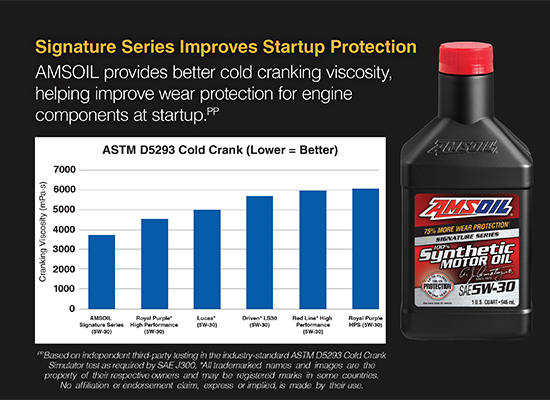
The following graphic shows results from independent third-party testing published by AMSOIL in 2024 using the industry-standard ASTM D5293 Cold Crank Simulator test required by SAE J300. In that comparison, the AMSOIL Signature Series 5W-30 formula tested demonstrated lower cold-cranking viscosity than the other 5W-30 oils shown. Lower cold-cranking viscosity means less resistance during startup in severe cold.
Heaters and Synthetic Oil Work Together
Block heaters, oil-pan heaters, battery warmers and other approved cold-weather aids can be valuable in sustained severe cold—especially for outdoor-stored vehicles, work equipment and applications where the manufacturer recommends preheating.
A heater helps reduce the burden of a cold soak, but the lubricant still needs to flow effectively when equipment has been unplugged, operating away from an outlet or exposed to severe overnight temperatures. A correctly selected synthetic lubricant can remain more fluid at low temperatures than a conventional alternative, helping reduce resistance during cranking and helping oil circulate sooner after startup.
One construction-site story has stayed with me: an owner had become accustomed to getting up early to make sure equipment heaters were on before the crew arrived. After switching the equipment to AMSOIL synthetic lubricants, he felt more confident that the equipment would be ready when the crew arrived because the oil remained more fluid in the temperatures the machines faced.
That is a real-world experience, not a promise that every machine can eliminate heaters. Follow the manufacturer’s guidance for your equipment and the conditions where it operates.
Need Help Choosing Oil for Severe Cold?
Use the owner’s manual and current manufacturer requirements as the starting point. If you would like help identifying an AMSOIL product that matches your vehicle or equipment and the temperatures it will face, contact Technilube.com with the year, make, model, engine and expected use.
Published September 2026. This page is reviewed periodically. Always follow current manufacturer requirements and product documentation for your vehicle or equipment.