Engine oil has always needed help to stay clean. Early engines relied on simple screens and strainers, while modern vehicles use advanced full‑flow and bypass oil filters designed to control wear‑causing particles. This page looks at how oil filtration evolved and what capacity, efficiency, flow and durability mean for today’s drivers.
Early Engines and Primitive Filtration
The earliest automotive engines ran with little or no oil filtration. Oil was usually drawn from a sump, pumped or splashed through the engine, then returned carrying wear metals, dirt and combustion by‑products along with it.
To keep the pump from clogging, designers added simple screens, wire mesh and coarse strainers to catch larger debris, but these primitive devices did very little to protect the engine from fine particles that cause most long‑term wear. Because oil quickly became saturated with contamination, drain intervals were short and engines needed frequent maintenance or rebuilds.
Purolator and the First Modern Oil Filters
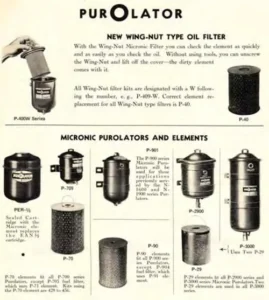 In the early 1920s, inventor Ernest Sweetland and his associate George Greenhalgh developed one of the first modern automotive oil filters. They named it Purolator, derived from “pure oil later,” and designed it to clean oil in the pressure‑side lubrication circuit so contaminants could be removed instead of simply circulating.
Purolator oil filters and similar designs showed that controlled oil filtration could extend engine life and reduce the need for constant oil changes. Early filters used materials such as cotton waste and later pleated paper to trap contaminants, laying the groundwork for the advanced full‑flow and bypass filtration systems that followed.
Full‑Flow vs. Bypass Filtration
As lubrication systems improved, engineers recognized two main ways to filter engine oil: full‑flow and bypass.
A full‑flow oil filter sits in the main oil circuit and routes all of the pump’s output through the filter before the oil reaches critical components. It must maintain high flow and catch damaging particles without starving the engine of oil, especially during cold starts or high‑load conditions.
A bypass filter cleans only a portion of the oil at a time, usually in a parallel circuit or “kidney loop” that takes a small stream of oil, filters it very finely, then returns it to the sump. Because bypass filters do not have to process all the oil instantly, they can use much finer media and target smaller particles and even some water contamination.
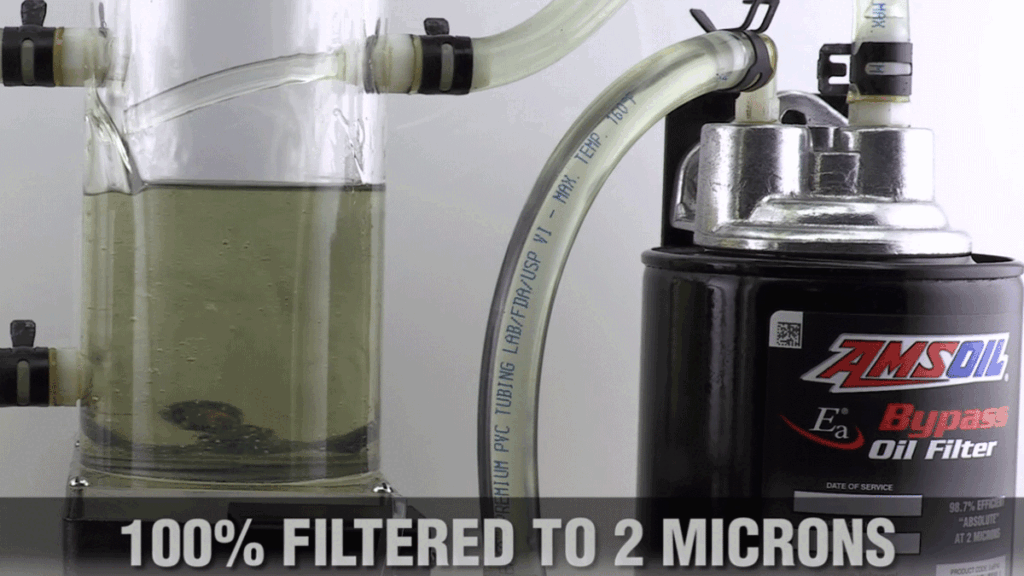
Full‑flow filters capable of handling 100% of the engine’s oil flow appeared in the early 1940s, and by the 1950s full‑flow spin‑on filters were common on mass‑production vehicles. Today, almost all automotive engines use full‑flow filters, with bypass systems added in some applications to improve ultra‑fine cleaning and extend oil life.
The Four Fundamentals of Filter Performance
Modern filters are judged by more than just whether they fit the engine. Four fundamentals define how well a filter actually protects the engine over time: capacity, efficiency, flow and durability.
Capacity
Capacity is the amount of contamination a filter can hold before it plugs or loses effectiveness. As oil circulates, the filter captures particles and soot until its media is loaded; once full, flow can be restricted or contaminants can begin to pass through.
Capacity matters more today because many engines use smaller oil sumps and run longer between oil changes. Less oil and longer intervals mean more contamination per unit of oil, so the filter has to hold more debris while still functioning properly.
Efficiency
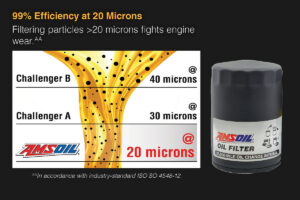 Efficiency describes how effectively a filter removes particles of a given size from the oil. It is often expressed as a percentage at a specific micron level under standardized testing—for example, 99% at 20 microns (ISO 4548‑12).
Traditional cellulose filters can have modest efficiency in the size range where much wear occurs, often leaving a significant number of small particles circulating. Premium synthetic‑media filters aim for much higher efficiency at those critical sizes.
Flow
Flow is the filter’s ability to let oil pass through quickly enough to supply the engine under all operating conditions. If the media is too restrictive or becomes clogged, the engine can be starved of oil, particularly during cold starts or sudden load changes.
Good filters balance tighter media spacing for better efficiency with designs that maintain adequate flow, using controlled fiber structures and internal support to keep the media open under pressure. Many systems also use bypass valves so that if the filter becomes severely restricted, oil can still reach the engine.
Durability
Durability reflects how well the filter media and its construction stand up to hot oil, pressure pulses and extended service intervals. Media held together with weaker resins or poorly supported pleats can crack, compress or shed fibers, reducing performance or causing the filter to fail.
Quality oil filters use robust housings, strong end caps, reliable gaskets and media support structures designed to maintain performance throughout the intended service life.
Media Evolution: From Paper to Advanced Synthetic Fibers
Filter media has evolved significantly since the early Purolator days. Early elements relied on cotton waste, cloth or simple meshes, and later disposable filters used pleated paper made from cellulose fibers. These designs worked reasonably well for larger particles and short drain intervals but had limited efficiency and capacity for fine contaminants.
Modern high‑performance oil filters often use advanced synthetic media with more uniform fiber size and spacing. Synthetic fibers can be engineered to create a depth structure that captures particles throughout the media thickness, increasing both capacity and fine‑particle efficiency while maintaining flow.
AMSOIL describes its full‑synthetic media as providing up to twice the contaminant‑holding capacity of many competing filters, while also delivering absolute efficiency of 99% at 20 microns in accordance with ISO 4548‑12. That kind of performance illustrates how far filtration has progressed from early paper elements.
Fine Particles and Water: Hidden Enemies
Much of long‑term engine wear is caused by contaminants that are too small to see with the naked eye. Particles in the roughly 5–20 micron range are similar in size to the clearances between bearings and other critical components, which means they can wedge between surfaces and act like very fine abrasives.
Full‑flow filters focus on removing particles quickly without restricting oil supply, which sets practical limits on how fine they can filter. Bypass filters and advanced media are used to target smaller particles and, in some designs, water contamination. Water in oil can lead to rust, corrosion and the formation of acids and sludge, all of which accelerate wear and reduce engine life.
By controlling both visible and microscopic contaminants, modern filtration systems help engines run cleaner and last longer even under demanding conditions.
By controlling both visible and microscopic contaminants, modern filtration systems help engines run cleaner and last longer even under demanding conditions.
Modern High‑Performance Filtration
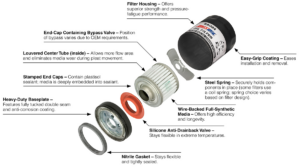 Today’s high‑quality filters combine the historical lessons of full‑flow and bypass filtration with advanced materials and testing. Many premium automotive filters use synthetic fiber media, robust construction and validated test performance to give drivers confidence in extended drain intervals and tough duty cycles.
AMSOIL filtration provides one example of what modern high‑performance filters can deliver:
- Full‑synthetic media designed for high efficiency and capacity.
- Absolute efficiency of 99% at 20 microns under ISO 4548‑12, meaning the filter consistently removes almost all particles at that size during testing.
- Strong internal support structures and quality gaskets and valves for durability throughout the service interval.
- Bypass filter systems that clean a portion of the oil down to very small particle sizes, complementing the full‑flow filter and reducing long‑term contamination.
These examples show how the basic principles of filtration—capacity, efficiency, flow and durability—translate into concrete design choices and measurable performance in modern products.
Why This History Matters
Oil filtration is often treated as a routine part of maintenance, but its history and fundamentals show how critical it is to engine life. From early engines with no filtration, through the first Purolator oil filters and the adoption of full‑flow designs, to today’s synthetic‑media and bypass systems, each step has been about controlling contamination more effectively so engines can run longer and more reliably.
When you choose an oil filter today, understanding that story—and the key performance dimensions behind it—turns a simple part number into an informed decision about how well the engine will be protected over time.